Summary of Three Parables in Luke 15
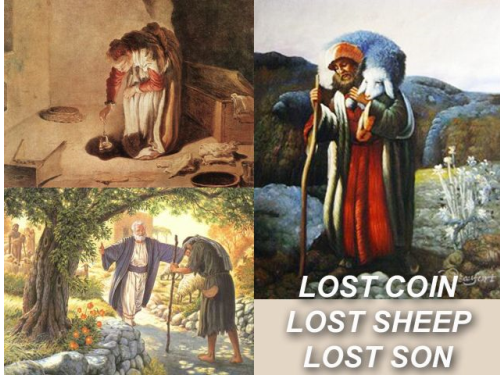
Three Parables in Luke 15
1. Parable of the Lost Sheep - Luke 15:3-7
2. Parable of the Lost Coin - Luke 15:8-10
3. Parable of the Prodigal Son - Luke 15:11-32
A. Introduction
In Luke 15 we found three parables. Two of these parables are only recorded in Luke. The parable of the lost sheep also occurs in Matthew 18:12-14. The Parable of the Lost Sheep (Luke 15:3-7), The Parable of the Lost Coin (Luke 15:8-10) and The Parable of the Prodigal Son (Luke 15:11-32) all tell of God's infinite mercy and love, even for all sinners. It is all about God's Love, His Mercy and His Forgiveness.
When Jesus entered humanity, He challenged the dominating views of His day about sinners, particularly those of the religious elite. Jesus rocked the status quo by sharing close fellowship with sinners. This is seen here in Luke 15.
Now that we know these parables we need to take note that Jesus was speaking to God's chosen, the Israelites before He laid down His life for us. Jesus was not yet crucified on the cross.
B. Key Word Meaning
A "sinner" is a person who is missing God's mark and is in fact missing the whole point of his or her life.
The meaning of sinner in the Greek means "to miss the mark."
Today we can look at these parables and see that this is referring to persons who moved away from God. Everyone who is separated from God through sin is a sinner. Sinner defines the broken state of one's relationship with God. Today we sometimes refer to backsliders. This word is not used in the Bible but we are familiar with it.
C. The Audience around Jesus
Here are three different translations below:
1. Luke 15:1-2 (NIV) "Now the tax collectors and sinners were all gathering around to hear Jesus. But the Pharisees and the teachers of the law muttered, This man welcomes sinners and eats with them."
2. Luke 15:1-2 (NKJV) "Then all the tax collectors and the sinners drew near to Him to hear Him. And the Pharisees and scribes complained, saying, This Man receives sinners and eats with them."
3. Luke 15:1-2 (KJV) "Then drew near unto him all the publicans and sinners for to hear him. And the Pharisees and scribes murmured, saying, This man receiveth sinners, and eateth with them".
D. Personal View on these three Parables
When I looked at these three parables it is clear that Jesus was referring to backsliders. In the parable of the Lost Sheep, one sheep got lost but was part of the herd before. In the Prodigal Son the younger son was part of a family with a loving father. In the Lost Coin parable the lost coin was part of 10 before it was lost.
The word "backslide", in a Christian context, implies a movement away from Christ.
A backslider is someone who is going spiritually the wrong direction. The backslider had at one time demonstrated a commitment to Christ or maintained a certain standard of behavior, but he has since reverted to old ways. Backsliding can manifest in several ways, dropping out of church, walking away from a ministry or a family, or falling back into old habits.
E Conclusion
In Luke 15 we had three parables - The lost sheep, the lost coin and the prodigal son. Jesus told these three to the same audience. Here we see the Trinity, the God Head, in this one chapter. In the parable of the Lost Sheep the shepherd is Jesus. In the parable with the Lost Coin the woman represents the Holy Spirit and in the parable of the Prodigal Son the father represents God the Father.
This parable means that God's love is unconditional, regardless of one's past transgressions. Jesus used this metaphor to convey the message that God's grace and forgiveness are available to all who repent for their past sins, symbolizing the joy and celebration of a sinner's return to righteousness and the loving embrace of a merciful Father.